Did COVID Kill Over-the-Board Chess?
Chess.com went from 30 million users to 150 million between 2020 and 2023. Online chess exploded. But what happened to the people who play real chess — over a real board, with a real clock, in a real tournament hall? I went looking for the answer in FIDE's data.
2.53M
Raw Records
217K
Active Players (2026)
~4%
COVID Participation
~32%
Pre-COVID Participation
The question nobody was asking
Everyone was celebrating the chess boom. Streaming, online tournaments, Queen's Gambit, Hikaru on Twitch — the narrative was clear: chess is thriving. But FIDE standard ratings only count over-the-board tournament games. Classical chess. Four hours. In person. The kind of chess where you sit across from someone, shake hands, and think for twenty minutes about a single move. I wanted to know: did that world survive the pandemic, or did it get quietly replaced?
Seven snapshots across a decade
I pulled seven official FIDE Standard Rating Lists spanning February 2015 to June 2026. Over 2.5 million raw records. After filtering out inactive players — anyone with zero tournament games in 12+ months — the dataset settled at 1.17 million records across 15 variables. Each snapshot is a photograph of the entire active FIDE-rated population at that moment: their rating, their age, their country, how many games they played. Seven photographs, ten years, one pandemic in the middle.
The collapse was real
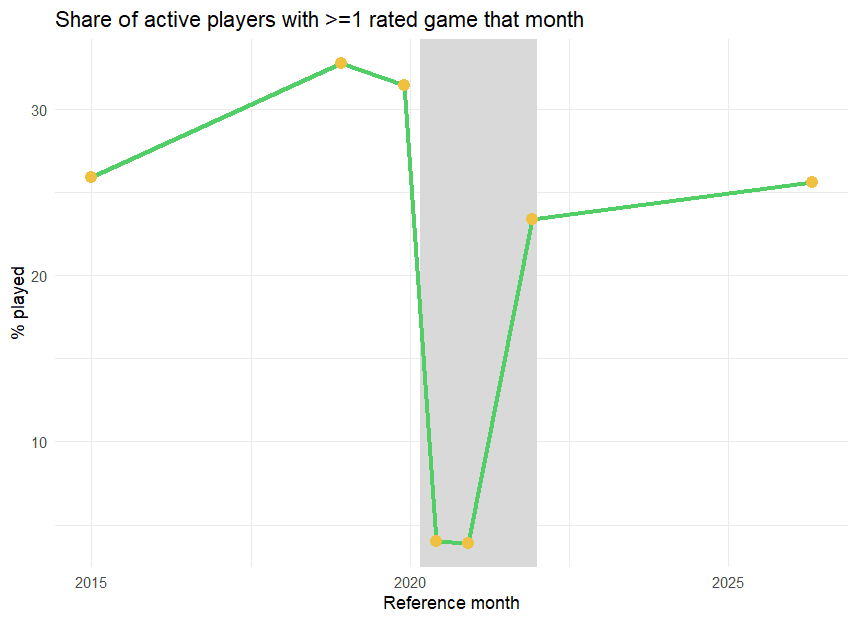
Pre-COVID, roughly 32% of active FIDE-rated players were playing at least one rated OTB game per month. During the pandemic, that number fell to 4%. Four percent. The chi-squared test confirmed this was not noise: χ² = 90,418 with a Cramer's V of 0.29 — a moderate but unmistakable association between the COVID period and participation collapse. Tournaments stopped. Travel stopped. Rating lists froze. The entire infrastructure of competitive classical chess went silent.
The recovery that was not quite a recovery
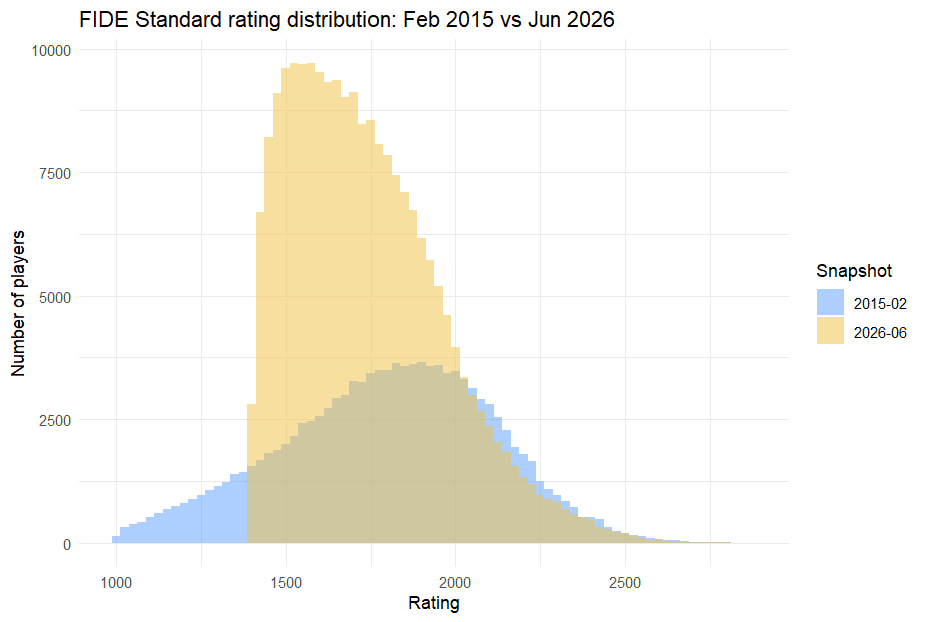
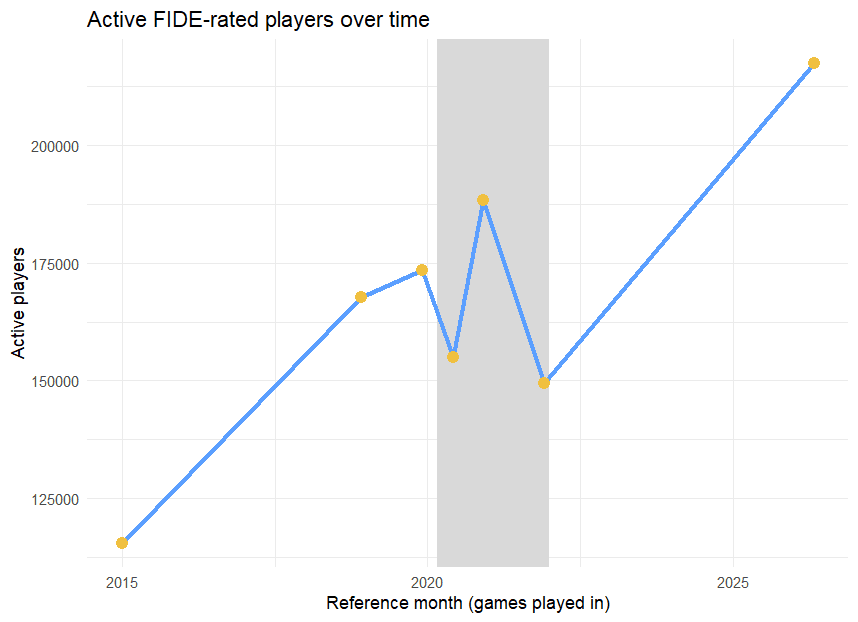
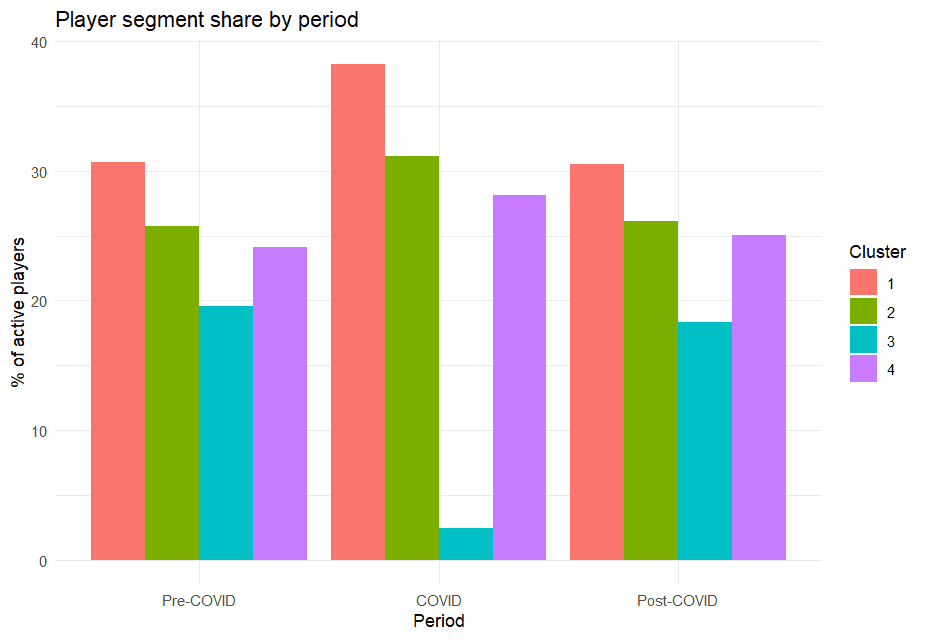
By post-COVID, participation climbed back to about 24%. Better than 4%, but still well below the pre-pandemic 32%. Meanwhile, the total pool of active FIDE-rated players nearly doubled — from 115,000 in 2015 to 217,000 by 2026. But average rating dropped from 1799 to 1737. The new players entering the system are overwhelmingly lower-rated beginners and club players. OTB chess got bigger in headcount but more casual in engagement. K-means clustering confirmed this: only the "regular players" cluster — the 14% who played 6+ games per month — was disrupted by COVID. The casual segments barely noticed.
The bottom line
OTB chess did not die. But it did not come back the same. The post-COVID base is larger, younger, less experienced, and less active than before. The infrastructure recovered — tournaments exist again — but the culture shifted. Classical chess is now competing for attention with its own online variants in a way it never had to before. The rating distribution tells this story: the 2026 curve is wider and lower than 2015, reflecting a flood of new, lower-rated players entering the system. The data does not say whether this is good or bad. It says what happened.